Inspection in the dark, with fully offline AI.
An edge AI system that runs on a single existing PC in the field and does not send images outside.
In development (a PoC at a manufacturing site is planned)
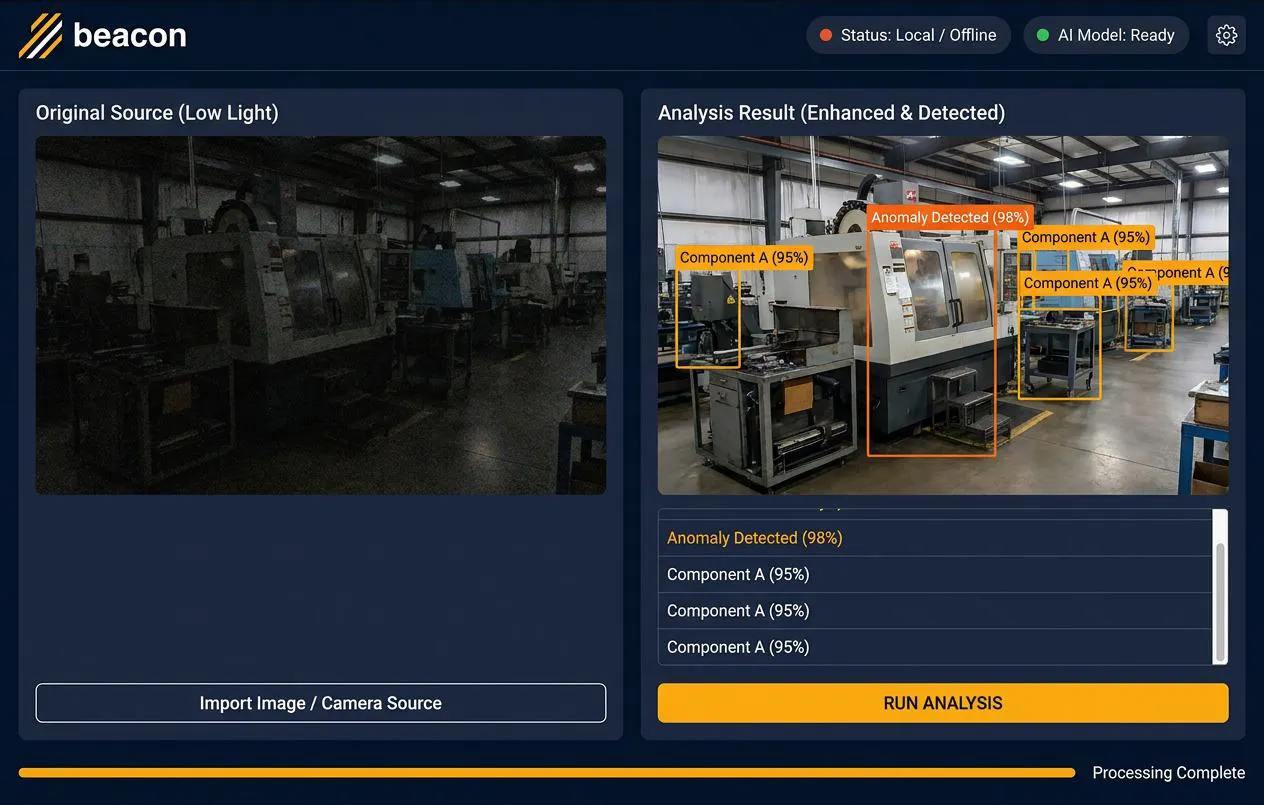
 The low-light original image (concept image)
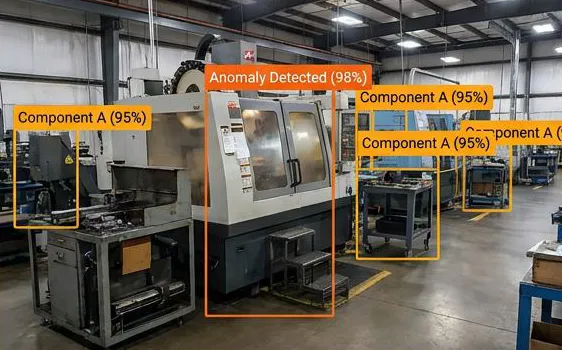 The result of image enhancement and object detection (concept image)
In the field, inspection in the dark still relies on the human eye
In visual inspections in dark places, anomalies and deterioration are more easily overlooked. Those oversights can lead to serious accidents and occupational injuries.
Image analysis by AI helps with this. Even so, one of the reasons companies hesitate to adopt it is the risk of information leaks that comes with sending images to the cloud.
From input to result
Beacon is an edge AI system that corrects images taken in dark places in the field so that they can be seen, and catches anomalies automatically. It combines low-light image enhancement and object detection with a local LLM. It runs on a single existing PC in the field and analyzes images without sending them outside.
- Image and instruction inputA natural-language prompt is added to a low-light image.
- Autonomous parallel processingThe system runs image enhancement and object detection at the same time.
- Immediate display of resultsThe results are shown on the screen in near real time.
The image enhancement method is published in papers and code
Beacon’s image enhancement uses a Retinex-based method by its developer, Toma Okugawa. XCR, which is fast and preserves structure, was published as a preprint in 2025, and its successor, SD-Retinex, in 2026.
SD-Retinex is a method designed around the derivative of the sigmoid function. It requires no training and runs on a CPU alone. Among the training-free CPU methods compared, it showed the best results.
From the SD-Retinex paper. Evaluated on the LOL dataset (eval15), on a CPU (AMD Ryzen 7 8840U).
| SD-Retinex | 16.47 dB |
|---|---|
| XCR | 9.83 dB |
| SSR | 8.99 dB |
| SD-Retinex | 18.4 ms (54 FPS) |
|---|---|
| XCR | 24.4 ms |
| LIME | 31.8 ms |
| SSR | 151 ms |
| MSR | 604 ms |
- The color difference ΔE (lower is better) was 15.9; all the other methods compared were 30.9 or higher.
- Without training, it outperformed the zero-reference deep learning methods Zero-DCE and SCI in both PSNR and ΔE.
Awards
Tongali Business Plan Contest 2026 (June 2026)
- NICT Award
- Supporter Award: JR Central Award
- Supporter Award: Beyond Next Ventures Award
- Tongali Award, 5th place
Starting at manufacturing sites, then on to disaster sites and medical care
- Short term (up to 1 year)PoC at manufacturing sites
- Medium term (2–3 years)Expansion to disaster and accident sites
- Long term (3+ years)On to medical care, inspection and night security